- Customer group: Guest
-


- Register
- Login
- Your account
- Home

- Details
- More images
Products description
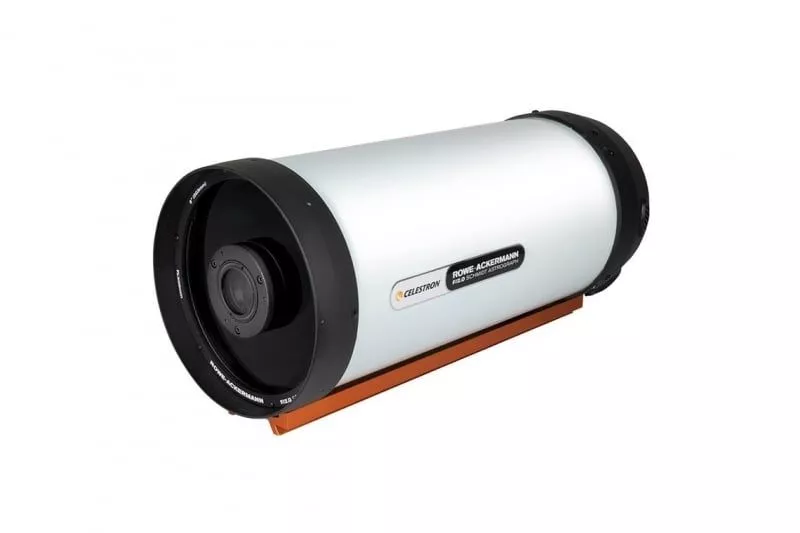
Here's an experience with the Celestron RASA 8
FIRST LIGHT WITH RASA 8, ATIK HORIZON, AND AVXSetup, Settings, Location, and Sky
On September 2, 2019, I experienced first light with the RASA 8. My setup included the RASA with a Telrad mount at the rear of the tube and the ATIK HORIZON Color camera, mounted via a variable Baader adapter (adjusted to exactly 1.2 cm), all on the AVX mount. The camera was connected to a standard 8 GB notebook via USB 3.0 with signal amplification through a 5-meter USB cable (which works significantly better than the unamplified USB cable supplied with the HORIZON).
Setup and adjustment took less than half an hour. The mount was aligned using two additional stars. It carries the RASA perfectly – which, incidentally, due to its short length, doesn't hit the mount during any flips or even at the zenith, and which doesn't require particularly precise weight balancing. A horribly overexposed 180-second test exposure facing west at the end of the test evening showed no greater star distortion than the 20-second shots taken earlier that evening. However, this was more of an academic test, as I used the HORIZON's standard low-gain exposure setting with 1x binning and took only 20-second exposures, multiplied by 120, without a light pollution filter. I focused the HORIZON as I did my f/4 Newtonian, using Live View in infinity – zooming in on the stars with 4x binning and then using the focuser to get them as small as possible (note: this was quite inaccurate for f/2). I fashioned a stray light shield out of craft foam, extending about 28 cm beyond the surface and slightly overlapping. It was stabilized by a cutout for the RASA's mounting rail, into which I could clamp the HORIZON's cables in an arc. This was intended to prevent unsightly spikes on the stars (and I can now confirm it does). That was all there was to it.
I took the photos from my balcony on the edge of the Rhine-Main region near Aschaffenburg, where the SQM reading was 21. The streetlights were on the other side of the building. The seeing was mediocre, the Milky Way was somewhat visible at the zenith, and the temperature was 18 degrees Celsius with light gusts of wind. The exposures began at 10:30 PM; the moon had just set. The RASA's cooling fan had been running for 45 minutes (and then all evening, which, according to Mr. Kloss and his very competent advice, wasn't necessary at all). The atmospheric temperature had dropped to 0 degrees Celsius.
I took the photos from my balcony on the edge of the Rhine-Main area near Aschaffenburg, where the SQM reading was 21. Motivation
Here's a brief explanation of my motivation for this setup. Horizon Color, AVX, and RASA 8 already give a lot away: Lightweight, quick setup and adjustment, along with avoiding long exposures—often requiring several evenings for monochrome—are my reasons for this setup. I enjoy taking pictures, but I enjoy observing even more. Furthermore, I often have a bad back, which makes me a bit sensitive to carrying heavy equipment and awkward bending. But what won't one do when it seems unavoidable? For astrophotography, I usually use the EQ 6 mount with a 10" f/4 Newtonian, which, given my limitations, demands quite a bit in terms of weight and settings. So, I wanted to let the RASA 8 handle the work without constantly checking everything, and I observed through a 12" Skywatcher Dobsonian during the exposures, which is also quick to set up and simply fun to use.
Lesson 1: Neatly Combining, Neatly Focusing
Given the RASA 8's wide field of view, I first chose a large target – NGC 7000, positioned near the zenith. I used ATIK's Artemis software for this, which is simple and quite stable. I didn't bother with anything else at this stage. The images were stacked the next morning in DSS (probably the most common setting, median and kappa-sigma), quickly post-processed in Photoshop in 10 minutes, as with test objects 2 and 3, by adjusting the individual color channels, gradation, brightness, and contrast. Finally, I corrected the gradients and reduced the background brightening with the Astroflat Pro module – a useful tool for me. Result: Apart from the general weakness of the ATIK HORIZON Color in reds, the colors were beautifully vibrant – and the stars were all slightly oval-shaped, which I only noticed with test object 2. The egg-shaped stars had two causes: firstly, it was quite warm during the day at 29 degrees Celsius, so the metal hadn't fully contracted when I assembled the equipment. Secondly, this contraction was further amplified by the cooling of the ATIK, which affected the RASA's camera adapter – the HORIZON loosened and tilted. Furthermore, everything was slightly out of focus, which is due to the fact that you have to be careful with the RASA's very sensitive focuser: two or three millimeters of rotation on the outer handle of the – incidentally, stable – focuser make a difference. I was careless there, especially since my f/4-10-inch Newtonian focusing method, using infinity live view with 4x binning to zoom in on stars and focus, was too imprecise below f/2 with the RASA.
Lesson 2: Good Resolution and Color
I wasn't entirely sure about this that evening and before processing the images. So I initially stuck with my focus strategy and, around 11:15 p.m., aligned the telescope with the Helix Nebula as my second target. I hadn't yet noticed the loosening of the horizon. Everything remained the same as with target number one. Due to its position, albeit close to the horizon, only slightly above the horizon, Helix isn't available at better times from my location. It's a persistent target I've observed several times, one that, at best, yielded a vague result within a single evening, because Helix lies to the south, towards the city, and is exposed to light pollution. And this time, I wasn't using a light-gathering filter. The result: a washed-out, blurry image, but with vibrant colors and light where it should be. Wow... and it was after this shot that I noticed the loosening of the horizon.
' ... Experience 3: Improved Focusing Strategy
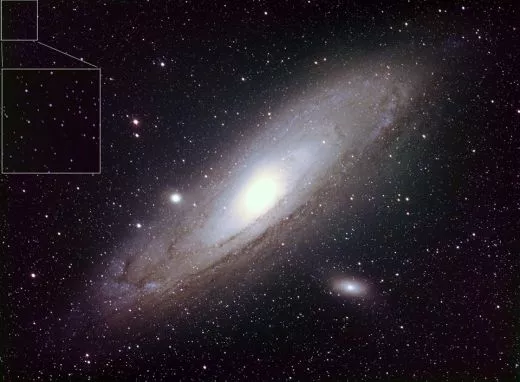
For the third target, around 12:30 AM – M31, located approximately 55 degrees east of the Spessart mountains and therefore less affected by light pollution – I checked and tightened the corresponding metal connections at the beginning. After the images of target 3, however, the HORIZON was a bit loose again, as I hadn't dared to tighten the screws any further. At least the stars in image 3 were now almost perfectly round. I then tried focusing in Live View with 2x binning, and this resulted in significantly greater accuracy (my setup can't handle 1x binning, which is due to the notoriously unreliable ATIK software, which simply stops working). Attempt 3 was therefore considerably better, although still in need of improvement (see the attached JPG). Again, I only made rough adjustments in Photoshop. The image depth is significantly better than with four times the total exposure time of the same subject on the TS 70mm Photoline triple APO, where the gain of the HORIZON has to be set much higher; the image is then coarser, and more precise tracking is required, thus necessitating a considerably longer exposure time. The ease of use is a major selling point of the RASA, and this is indeed true in practice.
Conclusion: Simple and fast
The RASA is very easy to handle – not heavy, with a practical carrying handle – and easier to focus than expected, provided you have an f/2-compatible method. Focusing remains stable for at least an hour; you just need to check the connection between the camera and the RASA occasionally.
Light pollution isn't a major issue with the RASA when observing bright objects like M31 and NGC 7000. Of course, this can be different with finer targets like galaxy groups. So, I'll be experimenting with different camera gains. I chose 20 seconds with the standard low gain to get the sharpest possible image, but this makes the image a bit too bright – so I'll probably switch to 15 seconds and more frames soon. I'll also be experimenting with filters (e.g., IDAS NB 1) when observing nebulae, as soon as Baader offers a suitable solution for filter use.
For an f/2 telescope, often demonized for longer focal lengths, the whole thing is surprisingly easy to use. An f/4 Newtonian requires more effort (but is, of course, also good for other things), while the RASA 8 is a specialist for one thing (wide-field observing), but it truly delivers on its promises and what I expected. Speaking of specialists: I bought the mount, camera, and RASA telescope gradually from Mr. Kloss, whose truly competent and clear advice has often talked me out of unnecessary or excessive purchases. The RASA 8 is a fantastic piece of equipment with incredibly simple handling that is a joy to use.
Dr. Werner W.
Link to the RASA 8" Rowe-Ackermann Schmidt Astrograph Telescope:
https://www.teleskop-spezialisten.de/…/RASA-8-Rowe-Ackerman…
This Product was added to our catalogue on 19/01/2020.
Categories
Quick purchase
Welcome back!
Last viewed:
Manufacturer
Shipping country
Payment methods

Die Box kann unter tpl_modified/boxes/box_miscellaneous.html verändert werden. Die Sprachvariablen befinden sich in der Datei tpl_modified/lang/german/lang_german.custom.
Teleskop-Spezialisten © 2026 | Template © 2009-2026 by modified eCommerce Shopsoftware