- Customer group: Guest
-


- Register
- Login
- Your account
- Home

- Menü
- Contact
- Legal Notice
- Checkout
- You do not have any products in your shopping cart yet.
- Your wishlist is empty.
Main pageCatalogueAstrophotographyTS Optics camerasPlayer One Apollo 428M MAX USB3.0 Monochrome Astro Camera, Sensor D=17.6 mm
- Details
- More images
Products description
Player One Apollo 428M MAX USB3.0 Monochrome Astro Camera, Sensor D=17.6 mm
The Apollo 428M MAX is an uncooled astro camera with a wide frame size, ideal for photographing the Sun and also suitable for deep-sky imaging.
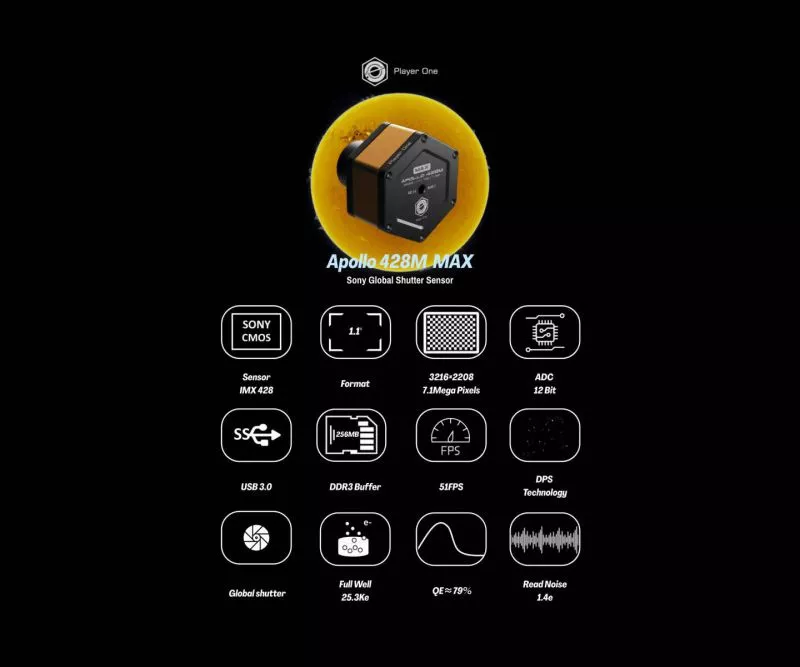
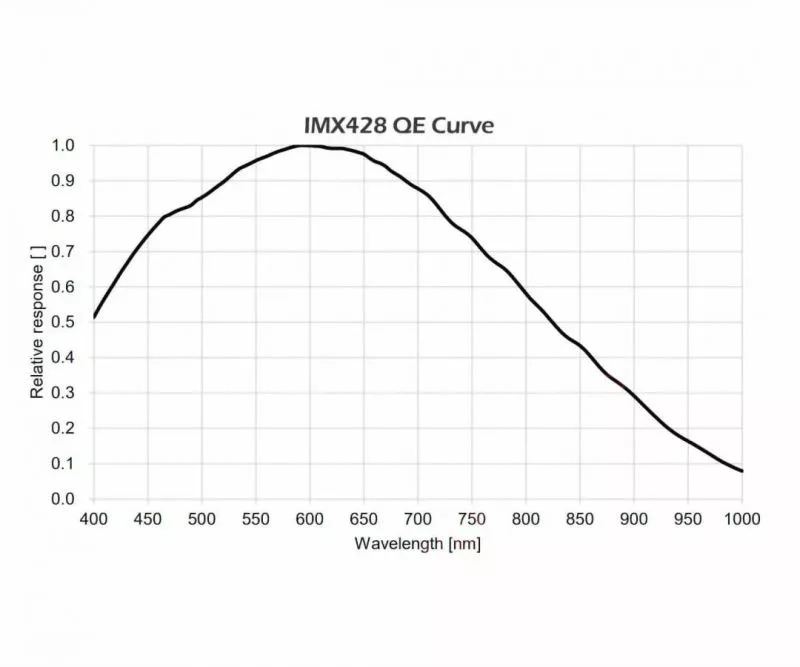
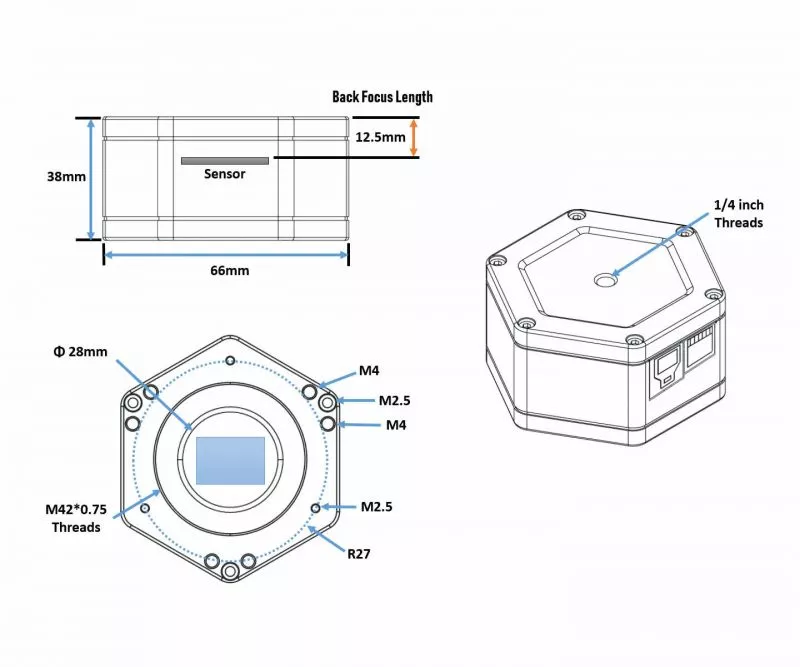
Sony IMX428 monochrome sensor with a diagonal of 17.5 mm (14.5 x 9.9 mm) 4.5-µm pixels for higher full-well capacity (dynamic range!) with good detail resolution Ideal for high-resolution images of the Sun without banding Good sensitivity extending into the infrared Also suitable for deep-sky imaging USB 3.0 for fast image downloads 256 MB DDR3 cache improves performance, especially on USB 2.0 ports Tilting mechanism to prevent Newton rings DPS (Dead Pixel Suppression) removes annoying dead (hot and cold) pixels from the image ARF clear glass filter protects the sensor from dust and allows IR light to pass through Includes ST4-level autoguiding interface - can be used as an autoguider with a large field of view PCS cooling - reduces the sensor temperature during long exposures The Sun and Moon are fully imaged up to a focal length of approximately 990 mm Flange focal distance (distance from sensor to T2 thread) is 12.5 mm 1/4" tripod thread on the back of the body Native driver as well as drivers for ASCOM and DirectShow are available (download links at the end of the detailed description)
Solar photography
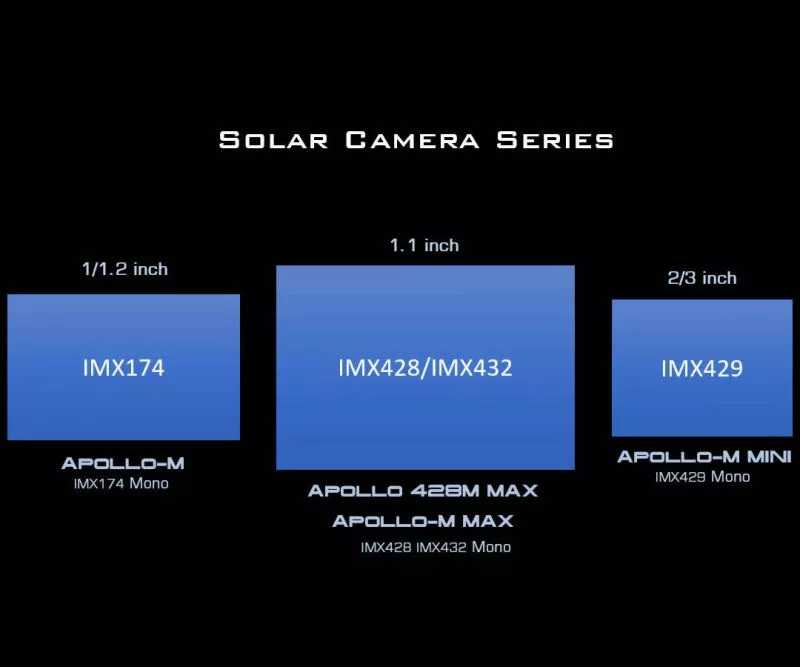
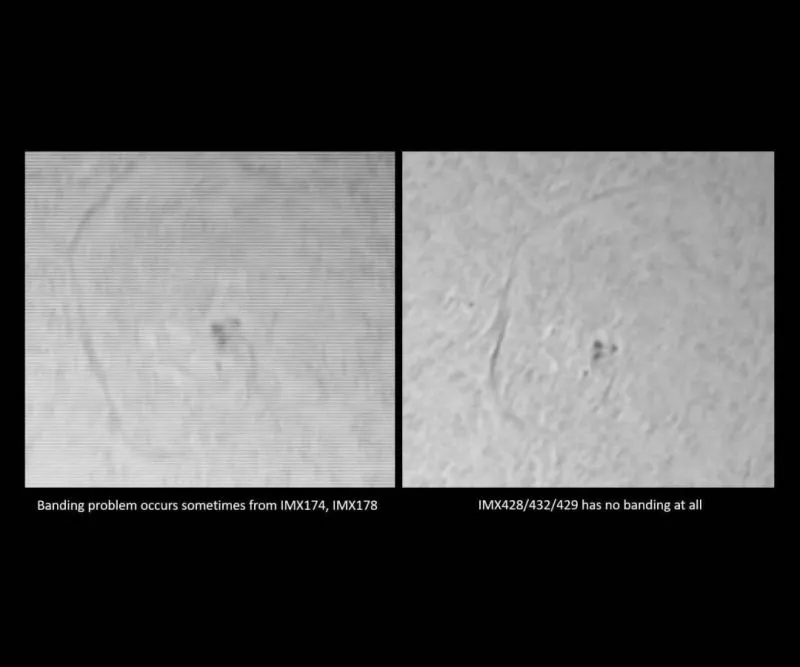
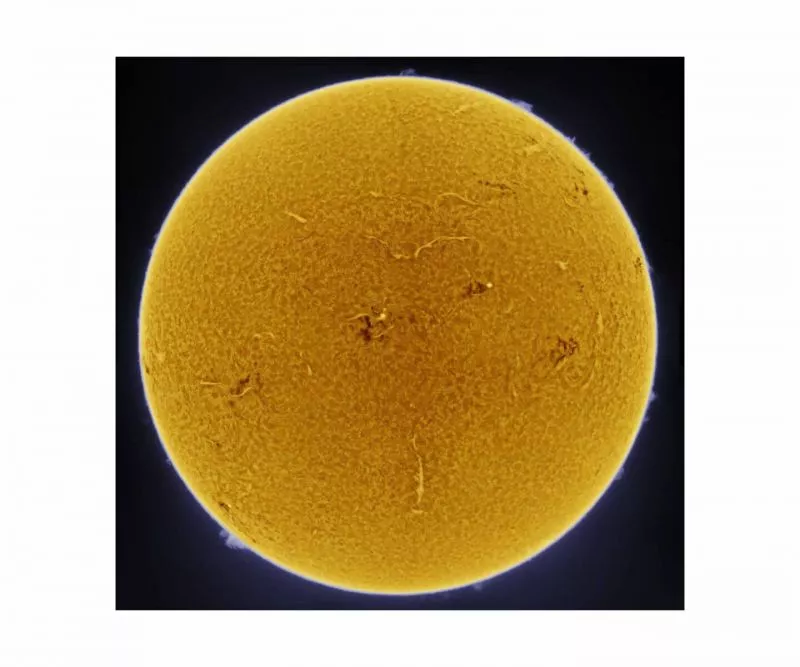
The Player One Apollo 428M MAX is specifically designed for solar photography, both in white light and H-alpha. A major advantage with the latter is that the IMX428 sensor does not suffer from the problematic ´banding´ shown in the sixth image. Sensor tilting, which this camera also offers, helps reduce Newton´s rings in solar photography. Unlike the similarly sized Player One Apollo-M MAX with its Sony IMX432 sensor, the pixels are significantly smaller, allowing for higher resolution of detail. 2x2 binning increases the full-well capacity, which expands the dynamic range.
Deep-sky photography
The large sensor with 17.5 mm diagonal makes the camera well suited for photography of nebular objects, star clusters and galaxies. The Sony sensor is very sensitive, so they can image faint objects well in just a few minutes. The lower sensitivity compared to the Player One Apollo-M MAX - due to the smaller pixels - can be compensated for by 2x2 binning. An HCG mode reduces readout noise and increases the dynamic range at higher gain settings.
Use as autoguider
At only 160 grams, the Player One Apollo 428M MAX is a lightweight. It puts hardly any strain on the focuser. Of course, the camera offers the ST-4 autoguiding interface. A 2 meter autoguiding cable is also included.
Anti-reflective clear glass filter protects the sensor from dust
The clear glass filter prevents dust from getting to the sensor. It also lets UV and infrared through, so you can also do infrared photography with the camera. You have full control over what light hits the sensor with the right choice of contrast filters, nebula filters, or UV/IR blocking filters.
DPS technology against "Hot and Dead" Pixels
The DPS (Dead Pixel Suppression) analyzes dark shots and selects the interfering pixels. In the shots (Light), these spurious pixels are overwritten and then no longer appear. The image becomes smoother. The technology works similarly to a dark frame.
Air cooling - reduces sensor temperature
During shooting, the sensor heats up. The PCS (Passive Cooling System) dissipates the heat from the sensor via a thermal pad. This reduces the sensor temperature by up to 15 °C compared to cameras without PCS.
Optional: ACS (Active Cooling System)
ACS is a external air-cooled system, designed for solar and big format planetary cameras which already has PCS (Passive Cooling System). ACS can provide much better temperature control. When camera has PCS + ACS, temperature is only 7 °C higher than ambient, camera body is a little warm but won´t be hot! ACS can not only be used in daylight for solar imaging, it also could be used in night for DSO lucky imaging.
Manual
The manufacturer provides a manual in PDF format; you can download it here.
Drivers and Software
The manufacturer´s software page contains various drivers as well as links to compatible capturing and editing software.
Large scope of delivery:

Player One Apollo 428M MAX monochrome astro camera for solar imaging, but also for deep-sky imaging
The Apollo 428M MAX camera is designed specifically for solar imaging, which adopts the Sony IMX428 1.1" format monochrome sensor. The 4.5 µm pixel size accommodates a well depth of 25.3 ke. The resolution is 3216 x 2208 (7.1 MP) and the diagonal is 17.5 mm.Solar photography
The Player One Apollo 428M MAX is specifically designed for solar photography, both in white light and H-alpha. A major advantage with the latter is that the IMX428 sensor does not suffer from the problematic ´banding´ shown in the sixth image. Sensor tilting, which this camera also offers, helps reduce Newton´s rings in solar photography. Unlike the similarly sized Player One Apollo-M MAX with its Sony IMX432 sensor, the pixels are significantly smaller, allowing for higher resolution of detail. 2x2 binning increases the full-well capacity, which expands the dynamic range.
Deep-sky photography
The large sensor with 17.5 mm diagonal makes the camera well suited for photography of nebular objects, star clusters and galaxies. The Sony sensor is very sensitive, so they can image faint objects well in just a few minutes. The lower sensitivity compared to the Player One Apollo-M MAX - due to the smaller pixels - can be compensated for by 2x2 binning. An HCG mode reduces readout noise and increases the dynamic range at higher gain settings.
Use as autoguider
At only 160 grams, the Player One Apollo 428M MAX is a lightweight. It puts hardly any strain on the focuser. Of course, the camera offers the ST-4 autoguiding interface. A 2 meter autoguiding cable is also included.
Anti-reflective clear glass filter protects the sensor from dust
The clear glass filter prevents dust from getting to the sensor. It also lets UV and infrared through, so you can also do infrared photography with the camera. You have full control over what light hits the sensor with the right choice of contrast filters, nebula filters, or UV/IR blocking filters.
DPS technology against "Hot and Dead" Pixels
The DPS (Dead Pixel Suppression) analyzes dark shots and selects the interfering pixels. In the shots (Light), these spurious pixels are overwritten and then no longer appear. The image becomes smoother. The technology works similarly to a dark frame.
Air cooling - reduces sensor temperature
During shooting, the sensor heats up. The PCS (Passive Cooling System) dissipates the heat from the sensor via a thermal pad. This reduces the sensor temperature by up to 15 °C compared to cameras without PCS.
Optional: ACS (Active Cooling System)
ACS is a external air-cooled system, designed for solar and big format planetary cameras which already has PCS (Passive Cooling System). ACS can provide much better temperature control. When camera has PCS + ACS, temperature is only 7 °C higher than ambient, camera body is a little warm but won´t be hot! ACS can not only be used in daylight for solar imaging, it also could be used in night for DSO lucky imaging.
Manual
The manufacturer provides a manual in PDF format; you can download it here.
Drivers and Software
The manufacturer´s software page contains various drivers as well as links to compatible capturing and editing software.
| Sensor: | SONY IMX428 1.1" CMOS Sensor (monochrome) |
| Diagonal: | 17.5 mm |
| Total Pixels: | 7.1 Mega Pixels |
| Max Resolution: | 3216 × 2208 |
| Pixel Size: | 4.5 µm |
| Sensor Area: | 14.5 mm × 9.9 mm |
| Frame Rate: | 51 FPS (10 bit), 27 FPS (12 bit) |
| Shutter: | Global shutter |
| Exposure Range: | 32 µs - 2000 s |
| Readout Noise: | 5.523 - 1.422 e |
| QE Peak: | 79% |
| Full Well capacity: | 25.3 ke |
| ADC: | 12 Bit |
| Cooling system: | Passive air cooling system PCS (can be retrofitted with active air cooling system ACS with fan) |
| Protective Window: | High Quality Anti Reflection Multi-Layer Coating |
| Data Port: | USB 3.0 / USB 2.0 |
| Adapter: | 1.25" / M42 x 0.75 |
| Back Focal Length: | 12.5 mm |
| Circumscribed circle of the hexagonal case: | 66 mm |
| Weight: | 160 g |
| Resolution and FPS (USB3.0 mode) 12 bit ADC: | 3216 × 2208 27 FPS |
| Resolution and FPS (USB3.0 mode) 1o bit ADC: | 3216 × 2208 51 FPS |
| More resolution options can be setup in the capture software.: |
Large scope of delivery:
| Manufacturer / Importeur: | Teleskop-Service Ransburg GmbH |
| Street: | Von-Myra-Str. 8 |
| ZIP / City: | 85599 Parsdorf |
| Country: | Germany |
| Telefon number: | +49 89 99228750 |
| Email: | info@teleskop-service.de |
| Website: | www.teleskop-express.de |
This Product was added to our catalogue on 18/07/2026.
Categories
- Advantages & disadvantages Information
- About us
- Telescope
- Telescope accessories
- Telescope Mounts
- Mounts Accessories
- Astrophotography
- Observing the sun
- 3D printing / developments
- Binoculars
- Microscopes
- Second Hand and Reduced
- Telescope Rent
- Service Offers
- Workshop Tutorial
- Astro gifts
- Astro-Blog / Testimonials
- * Special offers *
- product lists
- Special offers
- New products
Quick purchase
Please enter the article no. from our catalogue.
Welcome back!
Last viewed:
276,00 EUR
19 % VAT incl. excl. Shipping costs
Features:Tripod »
More information on your personal page »
Manufacturer
Shipping country
Information
Payment methods

Die Box kann unter tpl_modified/boxes/box_miscellaneous.html verändert werden. Die Sprachvariablen befinden sich in der Datei tpl_modified/lang/german/lang_german.custom.
Teleskop-Spezialisten © 2026 | Template © 2009-2026 by modified eCommerce Shopsoftware