- Customer group: Guest
-


- Register
- Login
- Your account
- Home

- Details
Products description
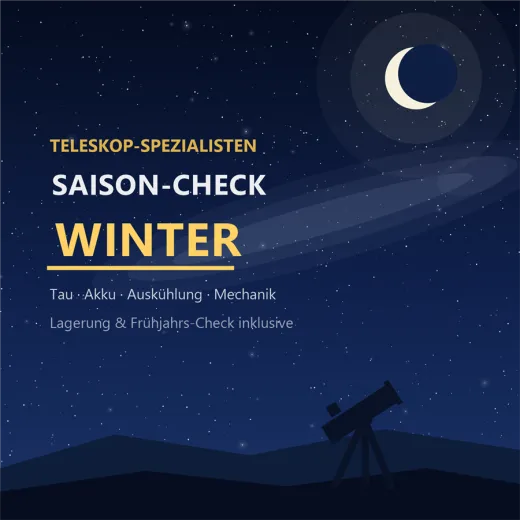
Telescope Fit for Winter: The Season Check
Cold nights are the sharpest – if dew, batteries and thermals play along. Here’s how to equip your gear for the best observing season of the year, and how it survives the winter.
1. Dew: enemy no. 1 of cold nights
Front lenses and sensors radiate into the sky and cool below the dew point. Against that:
- Dew shield – extends the time until fogging (our 3D-printed caps for C8, SkyMax 150/127, Explorer 150PDS are additionally blackened – double benefit: less stray light).
- Heater bands (USB/12 V) – the reliable solution; with PWM throttling you spare the battery.
- Tube fans – mitigate tube thermals that also eat contrast.
2. Batteries in winter: plan for capacity loss
- LiFePO4 power stations (Bresser 13 Ah, PowerTank class) lose considerable capacity in frost – store them warm inside, connect outside only when needed.
- Consumer budget: add up mount + camera + heater + hub; the field PSU standard is 12 V/10 A.
- Field trick from practice: power bank in your jacket pocket, only the heater band outside.
3. Cool-down: longer in winter than you think
Thermals in the tube are the number-one image killer in cold weather:
| Instrument | winter cool-down |
|---|---|
| Refractor 80–100 mm | 20–30 min |
| Dobson up to 8” | 45–75 min |
| SC/Mak 8” | 90–120 min (thermal cap with a hole!) |
The community trick: set the telescope out 30–60 min before the session – but protected (not in snowfall/dew zones).
4. Mechanics in frost
- Clamp screws only hand-tight – cold material is more brittle (there have been real breakage cases on altitude clamps).
- Grease gets stiff: the alt-az SkyTee class is known for that – it’s normal, not a defect. Move it fully through first, then judge.
- Nobody is play-free: bearing play on the mount is temperature-dependent – in winter it may be a touch wider.
5. After the season: storing properly
- Dry, temperature-stable, not in the damp garage. Silica bags into the equipment; for cameras, replace the desiccant.
- Don’t clean optics “on suspicion” – dust on the corrector doesn’t hurt (compressed air suffices); only real films get optical fluid and microfibre, circular, without pressure.
- Tube caps on, don’t force anything tight (relax the clamps).
6. The spring check (when it warms up again)
- Test collimation (Cheshire/laser) – transport shifts it.
- Move the axes: stiff? → workshop service instead of force.
- Firmware principle: “never change a running system” – updates only for a concrete fix.
- Replace hand controller batteries (corrosion over winter).
Our winter trio for beginners
- Dew cap matching your tube (shop 3D print)
- Bresser power bank 13 Ah (LiFePO4)
- Variable moon filter (€30 class) – the winter Moon is bright!
Teleskop-Spezialisten Karl Kloß · Grubmühl 20, D-82131 Gauting (near Munich), Germany · Tel. +49 (0)89 68050200 · info@teleskop-spezialisten.de · Clear skies!
This Product was added to our catalogue on 04/11/2026.
Frequently asked questions »
More information on your personal page »

Die Box kann unter tpl_modified/boxes/box_miscellaneous.html verändert werden. Die Sprachvariablen befinden sich in der Datei tpl_modified/lang/german/lang_german.custom.