- Kundengruppe: Gast
-


- Registrieren
- Anmelden
- Mein Konto
- Startseite

- Details
- Mehr Bilder
Produktbeschreibung
Baader Solar Projection Screen (BSPS) Sonnenprojektion
- Sichere Sonnenprojektion an Refraktoren mit Zenitspiegeln/-prismen
- Einfache Beobachtung der Sonne im Weißlicht – allein oder in Gruppen
- Schnelle und einfache Montage der gestanzten Kartonagen mit vormontierten Klebestreifen
- Geeignet auch als Nachführkontrolle, z.B. für die Öffentlichkeitsarbeit. Optimiert für seitlichen Einblick
- Für den Betrieb benötigen Sie (nicht im Lieferumfang)
- ein für die Sonnenprojektion geeignetes Linsenteleskop mit Zenitspiegel/-prisma und mindestens 3 cm Fokussierreserve (Backfokus). Empfohlen für Öffnungsverhältnisse ab ~f/6
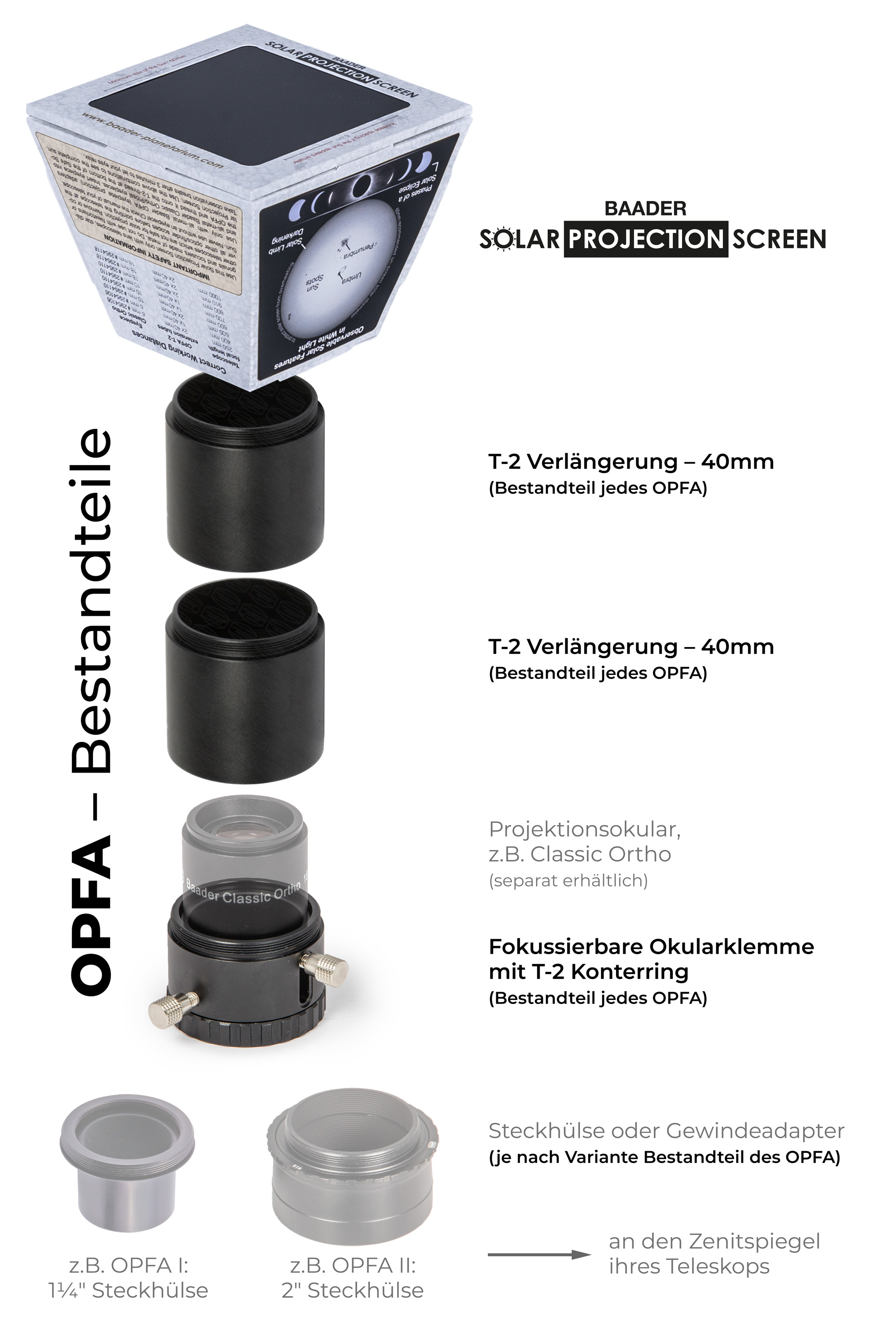
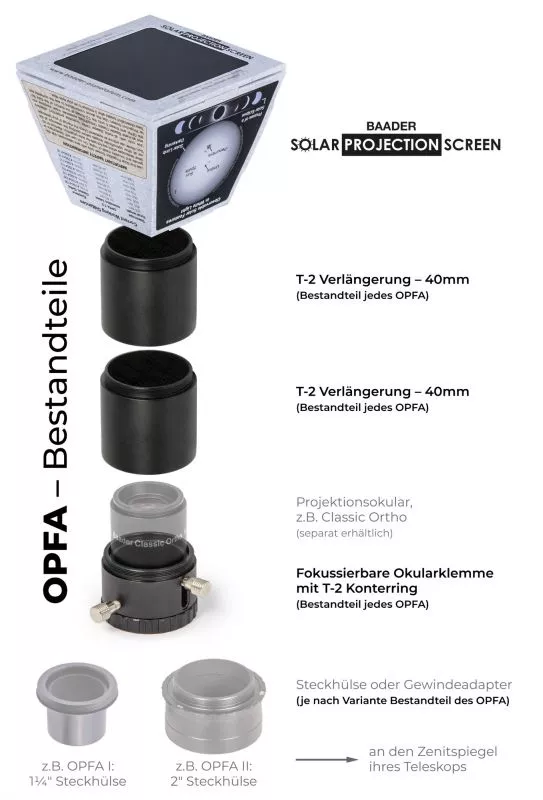
- Okularprojektionsansatz mit T-2-Anschluss, z.B. den Baader OPFA - Okular-Projektions Fokal Adapter (I - VII) (verschiedene Versionen erhältlich)
- Ein für die Sonnenprojektion geeignetes Okular aus Glas/Metall mit passender Brennweite, um ein mindestens 6 cm großes Sonnenbild zu projizieren. Getestet wurden der BSPS mit Baader Classic Ortho/Plössl Okularen.
Solar Projection Screen – Sonnenprojektionsschirm
Sichere Sonnenbeobachtung für kleine Gruppen
Der Baader Solar Projection Screen (BSPS) bietet eine sichere Möglichkeit zur Sonnenprojektion und erlaubt kleinen Gruppen die gemeinsame Beobachtung der Sonne. Der Sonnenprojektionsschirm ist ideal für die Beobachtung der Sonnenaktivität mit Sonnenflecken im Weißlicht und für die Beobachtung des Verlaufs von Sonnenfinsternissen.
Er besteht aus einer Rückprojektionsfläche und einem T-2-Gewinde zum Anschluss an gängige Okularprojektionsansätze. Der Schirm wurde mit dem Baader OPFA - Okular-Projektions Fokal Adapter (I - VII) (verschiedene Versionen erhältlich) entwickelt und getestet. Er liefert mit den passenden Baader Classic Ortho Okularen an Refraktoren zwischen 250 und 1200 mm Brennweite ein Sonnenbild, das die 9x9 cm große Projektionsfläche füllt. Sonnenflecken sind so ebenso zu sehen wie die Randabdunklung der Sonne und der Verlauf von Finsternissen. Er lässt sich auch mit anderen T-2 Projektionsansätzen als dem Baader OPFA verwenden; jedoch müssen Sie dann die nötigen Abstände selbst bestimmen.
Anders als bei klassischen offenen Projektionsschirmen besteht kein Risiko, dass jemand in den Strahlengang greift oder gar in das Okular schaut. Durch die Rückprojektion ist ein geschlossenes System möglich. Der Schirm kann an jedes für die Sonnen- und Okularprojektion geeigenete Teleskop angeschlossen werden.
Wenn das Teleskop auf einer nachgeführten Montierung genutzt wird, kann die Sonne so über mehrere Stunden hinweg entspannt beobachtet werden. Bei einer nicht perfekt eingenordeten Montierung läuft die Sonne dabei langsam aus dem Bild heraus. Anhand der Richtung können Sie bei Tag sehen, in welche Richtung die Ausrichtung der Montierung korrigiert werden muss, und die Montierung so während der Beobachtung genauer einnorden – eine Anleitung dazu finden Sie im PDF der ausführlichen Bedienungsanleitung.
Besonders hilfreich ist der Projektionsschirm bei der Öffentlichkeitsarbeit, wenn ständig andere Gäste in das Okular eines Teleskops mit eigenem Sonnenfilter schauen: Wenn der Schirm an einem weiteren, kleinen Leitrohr bzw. Sucher befestigt ist, können Sie so einerseits sehen, ob die Sonne noch im Hauptteleskop eingestellt ist, und den wartenden Gästen gleichzeitig zeigen, was sie erwartet.
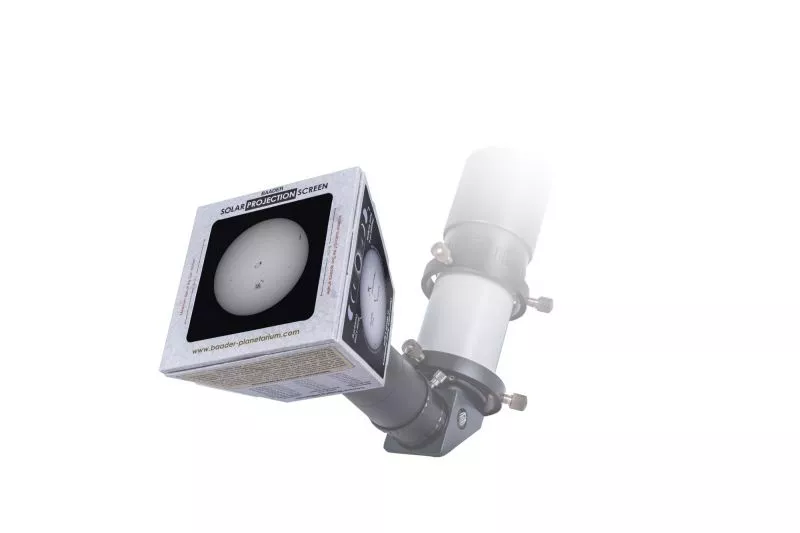
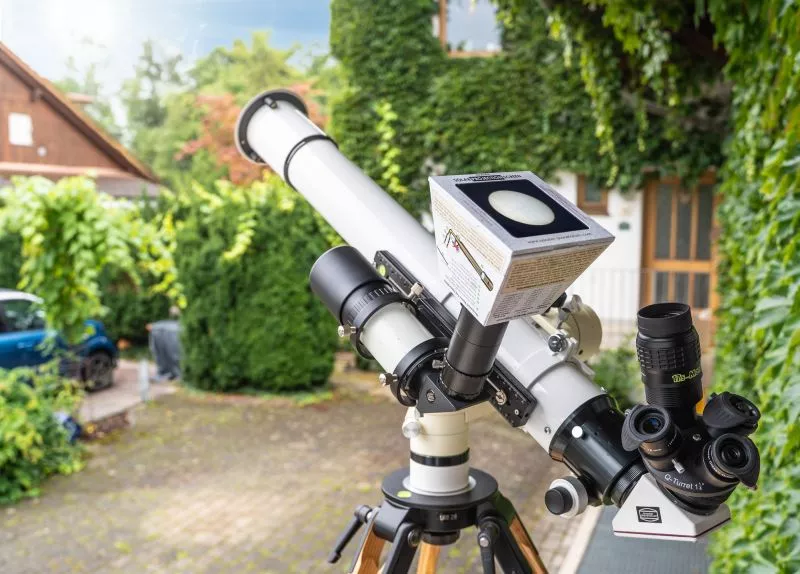
BSPS an Baader Vario Finder 10x60 auf Vixen 90x1000
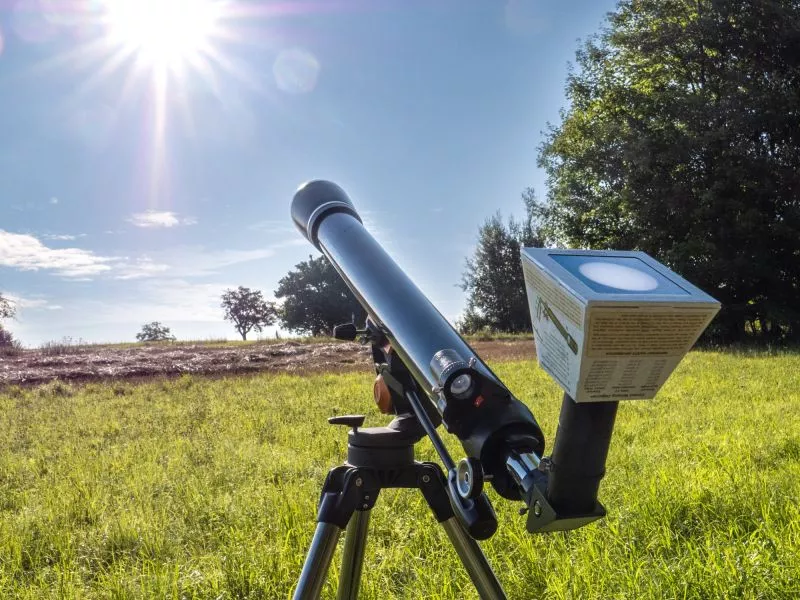
BSPS an Celestron AstroMaster 70 AZ
BSPS an Bresser AR 90/500
BSPS an Baader Vario Finder 10x60
BSPS an Baader Vario Finder 10x60 auf Vixen 90x1000
BSPS an Celestron AstroMaster 70 AZ
Voraussetzungen
Um den Solar Projection Screen nutzen zu können, benötigen Sie außerdem:
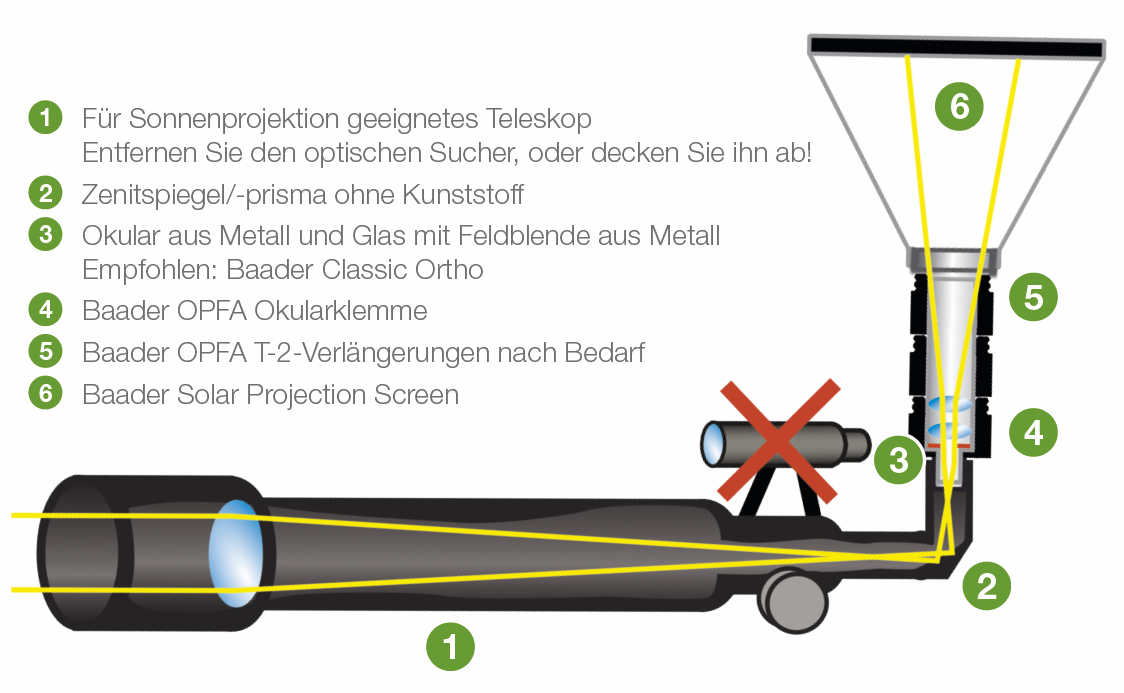
- Ein für die Sonnenprojektion geeignetes Teleskop samt Zenitspiegel/-prisma – idealerweise einen Refraktor mit 250-1200mm Brennweite. Der Projektionsschirm wurde an Teleskopen mit f/5 (90/500) und f/4 (VarioFinder 61/250) ebenso getestet wie an 150/1200mm und 150/2250mm Refraktoren, jeweils über mehrere Stunden und mit voller Öffnung. Um die Belastung für den Zenitspiegel gering zu halten, empfehlen wir lichtstärkere Teleskope als f/6 sowie Teleskope mit mehr als etwa 80mm Öffnung ggf. abzublenden. An Teleskopen bis etwa 1200mm Brennweite kann die gesamte Sonne abgebildet werden; größere Teleskope vergrößern stärker und zeigen nur einen Ausschnitt.
- Einen variablen Okularprojektionsansatz mit T-2-Anschluss. Der Solar Projection Screen wurde für den Baader OPFA entwickelt. Der Durchmesser des Sonnenbilds hängt vom Abstand zur Projektionsfläche ab.
- Der Okularprojektionsansatz Okularprojektionsansatz OPFA I – mit 1¼" Steckhülse (#2458141 , ¤ 63,- ) hat einen 1¼" Anschluss;
- der Okularprojektionsansatz Okularprojektionsansatz OPFA II – mit 2" Steckhülse (#2458142 , ¤ 80,- ) passt für Zenitspiegel/-prismen mit 2" Steckhülse.
- Wenn Sie einen Baader Zenitspiegel-/prisma mit T-2-Anschluss verwenden, können Sie den Okularprojektionsansatz Okularprojektionsansatz OPFA IV – Basisversion mit T-2i (#2458144 , ¤ 55,- ) direkt an das Gehäuse anschrauben und so Backfokus sparen.
- Ein hitzebeständiges Okular. Neben den üblicherweise für die Sonnenprojektion empfohlenen Huygens-Okularen (die heute kaum noch in guter Qualität zu finden sind) können Sie die Baader Classic Ortho Okulare mit 6, 10 oder 18 mm Brennweite oder das 32mm Baader Classic Plössl verwenden.
- Die meisten Teleskope, die ausreichend Backfokus für die Okularprojektion bieten, können auch mit dem Solar Projection Screen genutzt werden. Der Solar Projection Screen benötigt etwa 30mm Backfokus. Alternativ kann der OPFA über das T-2-Gewinde auch mit einem T-2-Prisma wie T-2 / 90° Zenitprisma mit 32mm Prisma inkl. Okularstutzen und Steckanschluss (#2456005K , ¤ 136,- ) direkt verschraubt werden, um eine sehr kurze Adaption zu erreichen.
Aufbau & Verwendung
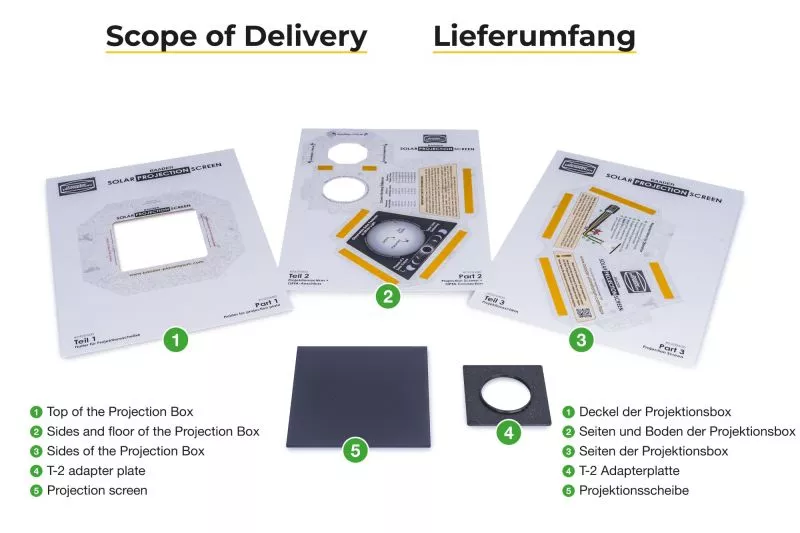
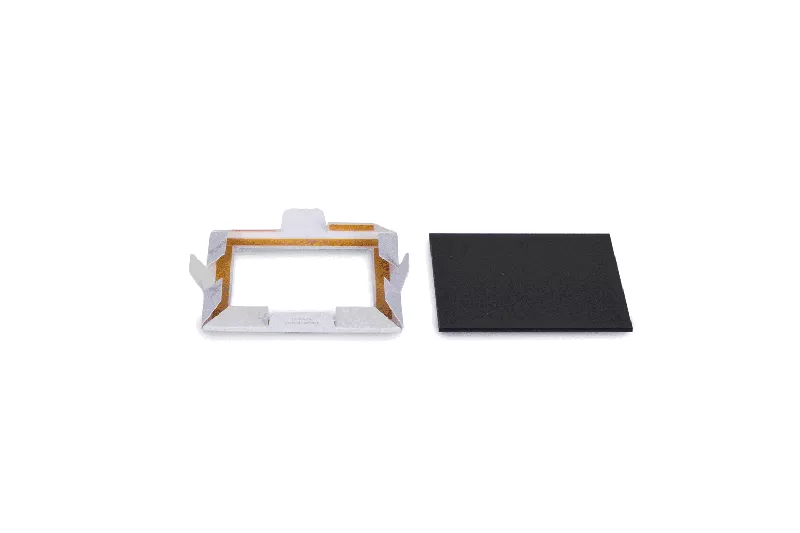
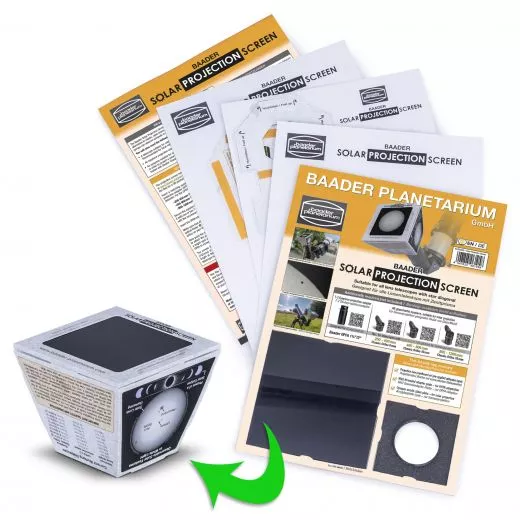
Der BSPS besteht aus dem speziellen Projektionsschirm, einem T-2 Gewindeadapter und einem vorgestanzten Kartonbausatz aus drei Teilen mit vormontierten Klebestreifen, um das Gehäuse zu bauen. Alternativ können Sie auch die STL-Dateien herunterladen, um selbst ein Gehäuse samt Schutzdeckel aus Kunststoff auf einem 3D-Drucker herzustellen.
Entfernen Sie alle optischen Sucher von Ihrem Teleskop bzw. decken Sie die Objektive aller ggf. noch installierten Optiken ab.
Setzen Sie das Okular in den Projektionsansatz, entfernen Sie falls nötig T-2-Verlängerungshülsen entsprechend der Anleitung, um den Abstand anzupassen, und schrauben Sie den Projektionsansatz an die Safe Solar Box. Setzen Sie dann beides in Ihr Teleskop mit Zenitspiegel (am Refraktor) ein, richten Sie es auf die Sonne und stellen Sie scharf. Über den Schiebefokussierer des OPFA (oder anderer variabler Okularprojektionsadapter) können Sie die Größe des projizierten Sonnenbilds noch etwas verändern. Um die Sonne im Teleskop einzustellen, können Sie den Schattenwurf des Tubus oder der Rohrschellen verwenden, oder einen speziellen Sonnensucher.
Die richtigen Kombinationen
| Brennweite des Teleskops | OPFA mit folgenden Verlängerungshülsen (im Lieferumfang des OPFA enthalten) | Classic Ortho Okular |
| 250 mm (Baader VarioFinder 10x60) | 2x40 mm | Classic Ortho 6mm, 1¼" Okular (HT-MC) (#2954106 , ¤ 73,- ) |
| 400 mm (Celestron PowerSeeker 80/400) | 1x40 mm | |
| 500 mm (Bresser AR 90/500) | 2x40 mm | Classic Ortho 10mm, 1¼" Okular (HT-MC) (#2954110 , ¤ 73,- ) |
| 580 mm (Baader APO 95/580) | ||
| 600 mm (Celestron ED 80/600) | 1x40 mm | |
| 700 mm (Celestron Inspire 70/700) | ||
| 910 mm (Vixen 80/910 Mf) | 2x40 mm | Classic Ortho 18mm, 1¼" Okular (HT-MC) (#2954118 , ¤ 73,- ) |
| 1000 mm (Vixen 90/1000) |

Hinweis: Um an Teleskopen mit 1,25"-Auszug in den Fokus zu kommen, musste der OPFA teilweise direkt mit dem T-2 / 90° Zenitprisma mit 32mm Prisma inkl. Okularstutzen und Steckanschluss (#2456005K , ¤ 136,- ) verschraubt werden.
Baader Solar Projection Screen (BSPS)
Produktdaten
- Artikelnummer
2420400 - EAN Code
4047825061058 - Hersteller
Baader Planetarium - Nettogewicht (kg)
0.00
Optische Eigenschaften
- benötigter Backfokus
30mm - Sonnenlicht-Wellenlänge
Weißlicht (integrales Licht)
Mechanische Eigenschaften
- Innendurchmesser / Freie Öffnung (mm)
T-2 (M42) - Sonnenfilter mit Fassung/Gewinde?
Ja
Diesen Artikel haben wir am 29.01.2026 in unseren Katalog aufgenommen.
Profitieren Sie von unseren Erfahrungen als Teleskop-Spezialisten:
denn sehen heißt verstehen
in besonderen Fällen auch Vor-Ort-Service im Raum München
Filter für Sonnenbeobachtung »
Mehr auf Ihrer privaten Seite »

Die Box kann unter tpl_modified/boxes/box_miscellaneous.html verändert werden. Die Sprachvariablen befinden sich in der Datei tpl_modified/lang/german/lang_german.custom.