- Customer group: Guest
-


- Register
- Login
- Your account
- Home

- Details
- More images
Products description
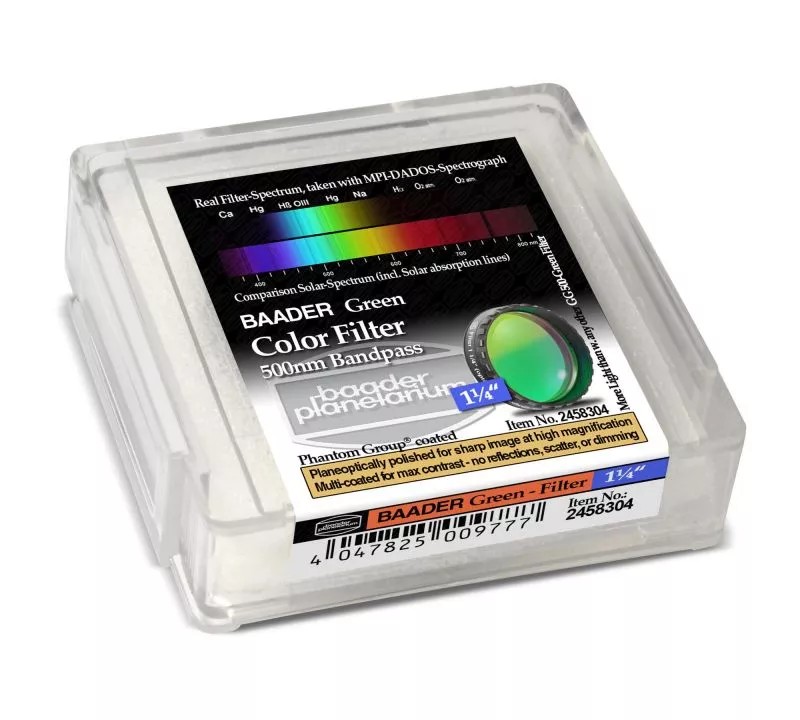
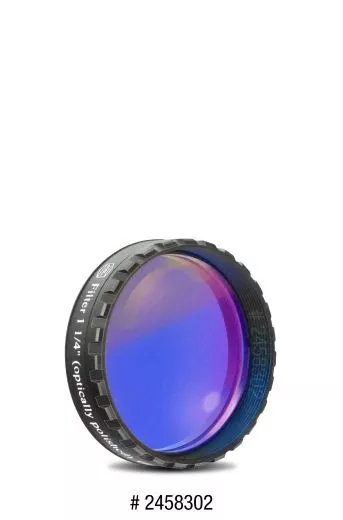
Baader color filter 1¼"
Colour filters for increased contrast of lunar and planetary observations
"Less is more!" Better a few filters with high optical performance produced for astronomical observations than whole mountains of filters with mediocre quality.
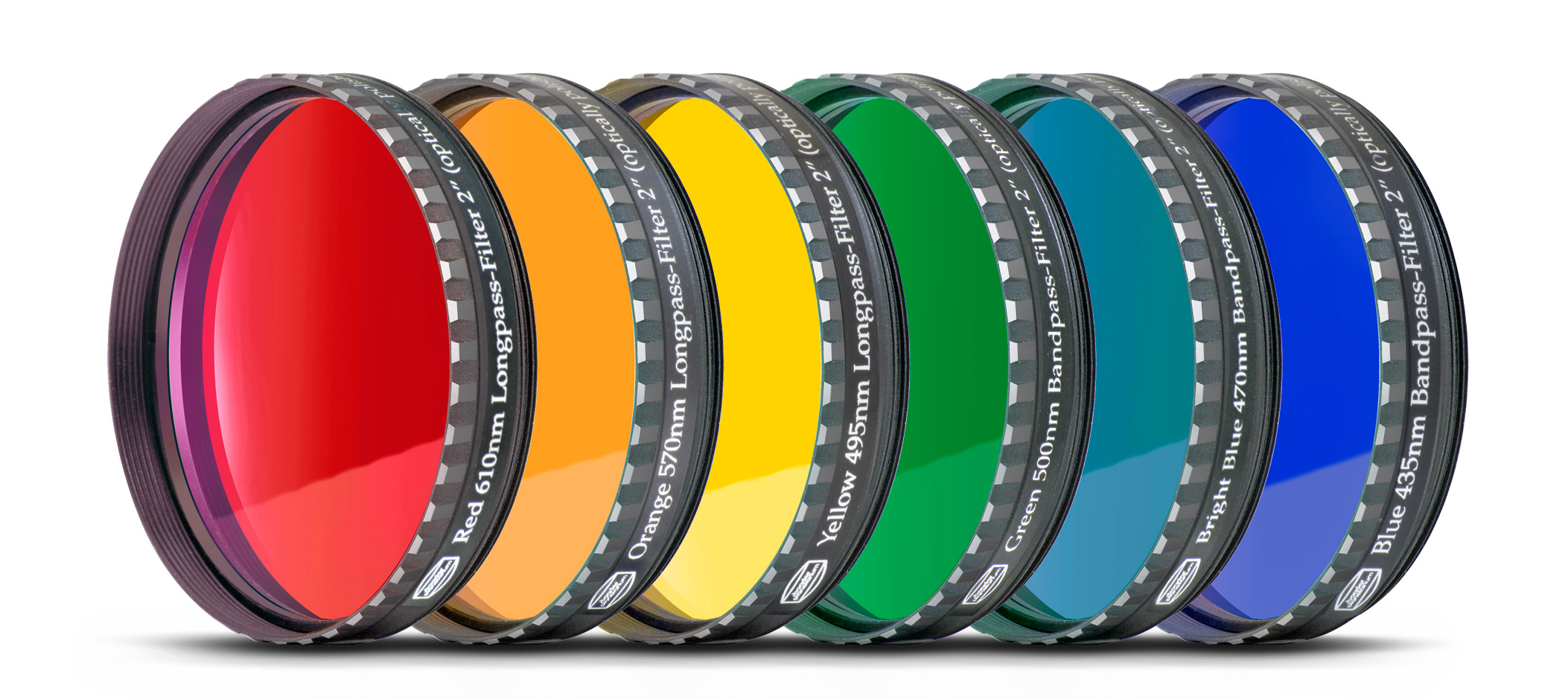
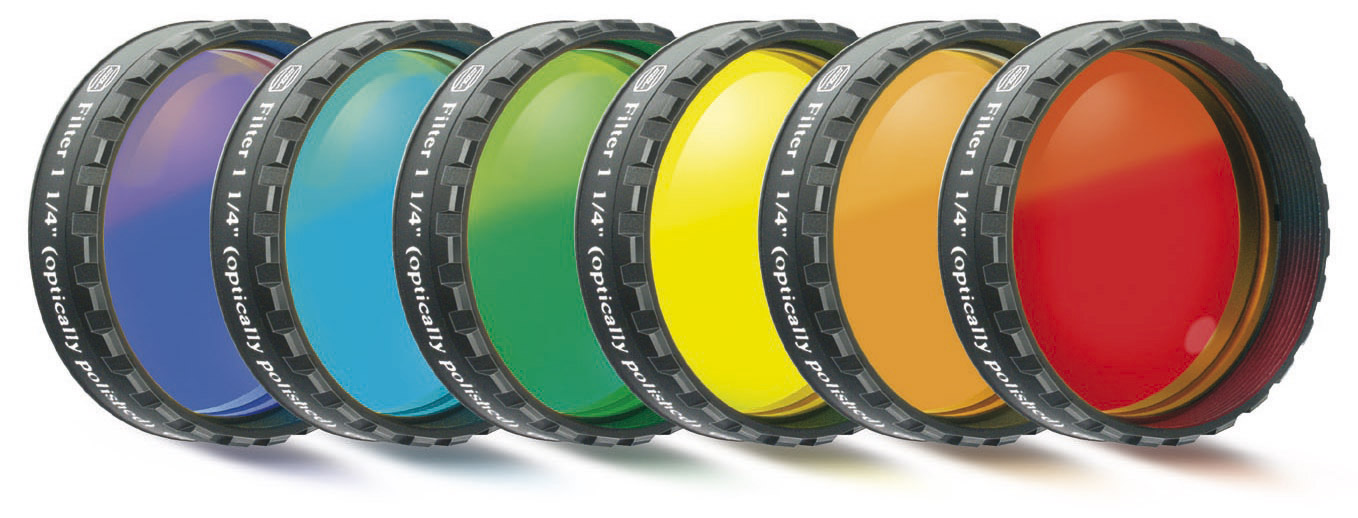
The Baader colour filters are carefully prepared for amateur astronomical interests. The glass are coplaner fine optically polished. These filters exceed the quality of the usual "raw polished" (hot flamed) coloured glass filters.
Because they are fine optically polished, these filters can be at any point in the mean path - far ahead of the focal point (for example, in front of a binocular approach!) without causing defects (astigmastism) or to degrade the image otherwise in any way!
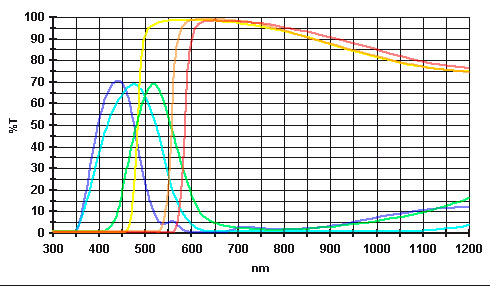
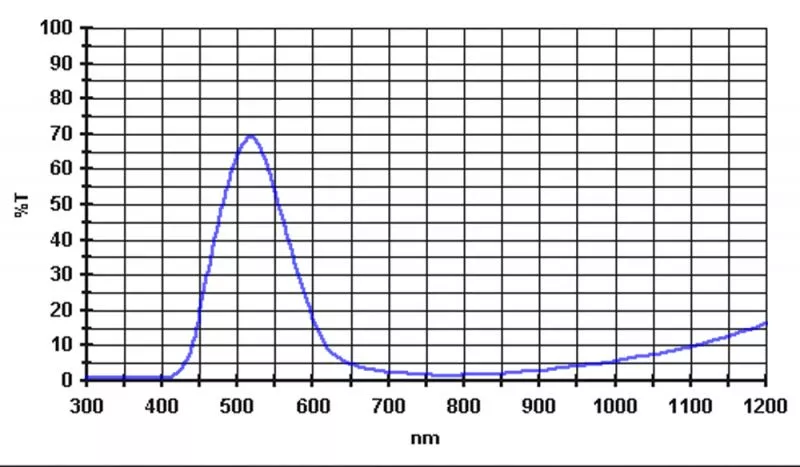
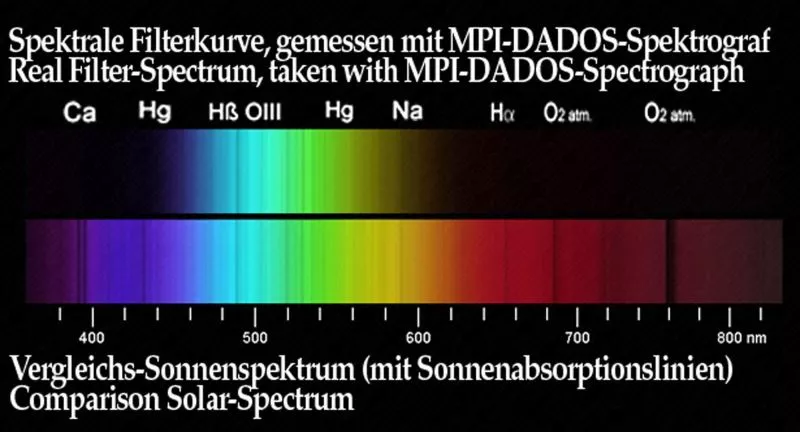
The parallelisn of the optical surfaces is excellent with 30 arcseconds. Double images are absolutely excluded. For each filter colour, the transmission curve is supplied as a measurement protocol.
Colour filters are often identified with a Kodak Wratten number (W-point). Baader colour filters were collected by astronomical experience and correspond to the respective wavelength range following filter by Wratten nomenclature: Baader-red filter ≅ W25, Baader-Orange filter ≅ W21, Baader-yellow filter≅ W12, Baader-green filter≅ W58, Baader-light blue filter ≅ W80A, Baader-dark blue filter≅ W38A
These filters are screwed into the filter thread of eyepieces or planetary imaging cams (Skyris). A thread at either end of the filter allows the filters to be combined with each other or with other filters (for example with a Baader UV / IR infrared cut filter).
Click here to enlarge
Features at a glance
- Largest free opening of all colour filters on the market to elimante any vignetting.
- CNC machined "grip crown" provides excellent handling and comfort.
- Both sides 7-layer AR coating with only 0.25% residual reflection per surface. This is the most antireflective that has ever been undertaken with color filters.
- The most important criterion for any kind of light filtering is brigthness. Certain spectral ranges at high magnification will only work at the highest light transmittance.
- The long-pass filter in this filter set offers 98% transmission and produces no flare. Unmatched by other brands. This can be seen in comparison with standard colour filters at once - the filter colour radiant downright.
- The combination of our infraread (IR) cut filter 1¼" and the RG 610 red filter results as an extremely narrow-band H-α pass filter for the CCD photography of red emission nebulae - at a ridcidulously low price!
- A wide range of adaptors allow the uses of T-2 photo threads (See: Baader Astro T-2 System™).
The classic yellow filter doubles as exoplanet filter
Modern amateur astronomers have always had professional equipment at their disposal that also allows scientific work. In the observation of variable stars and the hunt for comets, cooperation with professional astronomers is nothing new. However, few people know that the hunt for exoplanets - which was only successful for the first time in the 1990s - is today also possible with amateur equipment.
In chapter 7 of his book Exoplanet Observing for Amateurs (downloadable from the author's website), Bruce L. Gary recommends a CBB or Clear Blue-Blocking Filter: that is, an otherwise translucent filter that blocks blue (and UV). The light curve of our Colour Filter Yellow (495nm) meets these requirements for a CBB filter.
With maximum transmission in visible light, it also fulfils the second requirement for exoplanet hunting: since long exposure times are necessary, it does not swallow light unnecessarily and thus does not prolong the exposure time.
No wonder that creative suppliers have started to market yellow filters as new exoplanet filters. It is important to know that common cheap colour filters for planetary observation have neither an optical polish nor high-quality coatings and are therefore useless for qualitatively challenging photographic applications. However, this is not the case with our colour filters. All our colour filters are finely optically polished and 7-layer multi-coated on both sides. Our normal yellow filter is therefore equivalent to yellow filters which are offered with the title CBB filter – but which cost much more than our filter. We are pleased that our yellow filter is not only useful to increase the contrast of the members of our own solar system, as it has been for years, but can also be used for the search for alien worlds - without any extra charge for this additional task.
Baader Phantom Group Coating™
Developed by Baader Planetarium the coating is a 7-layer broadband coating with extremely low residual reflection. The term "Group" indicates that the respective most effective anti-reflection layer system was calculated for each type of glass of the filter.
This means that the anti-reflection layers of different colour filters are different. They are calculated to provide the mximum for the respective filtered colour transmission values.
Both sides of the filter are coated with 7-layer AR coating with only 0.25% residual reflection per surface. This is the most that has ever been provided for colour filters. The filter discs are screwed into the blackened aluminium frames and are delivered within a filter. Each filter is designed for multiple applications.
Optical Specifications
- AR-CoatingPhantom Coating® Groupplaneoptically polished
- Type of Filter
- Bandpass
Mechanical Specifications
- Filter mountedMounted (LPFC 6mm)
- Filter shaperound
- Filter size1 25 inch
- Filter Thickness (without cell)2 mm
Usage & Features
- Filter UsageColorPlanetary
- Single or Set?Single Filter
Safety:
Baader Planetarium
www.baader-planetarium.com
This Product was added to our catalogue on 30/01/2025.
Color filter / moon filter »
More information on your personal page »

Die Box kann unter tpl_modified/boxes/box_miscellaneous.html verändert werden. Die Sprachvariablen befinden sich in der Datei tpl_modified/lang/german/lang_german.custom.