- Customer group: Guest
-


- Register
- Login
- Your account
- Home

- Details
- More images
Products description
Antlia 2" ALP-T Dual Band Narrowband Nebula Filter for S-II and H-Beta - 3.5 nm
The 2" narrowband nebula filter enables extreme-contrast nebula photography with monochrome and color cameras – light pollution is no longer an issue.
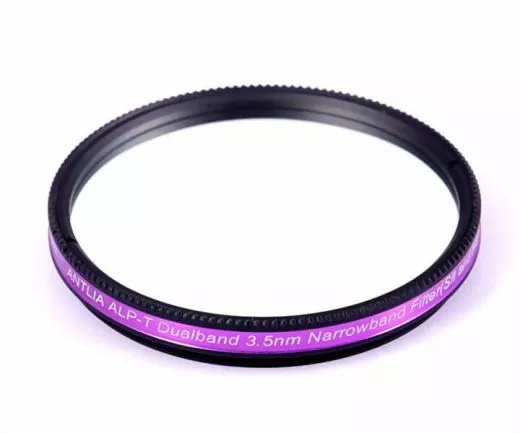
2" low-profile filter mount with M48x0.75 thread
Suitable for telescopes and lenses with an aperture ratio of f/4 and lower
Optical glass as the base substrate
Blackened edges to prevent internal reflections
Extremely narrow bandwidth of only 3.5 nm for maximum contrast
Precise transmission in [S II] and H-beta
Filter thickness: 2 mm
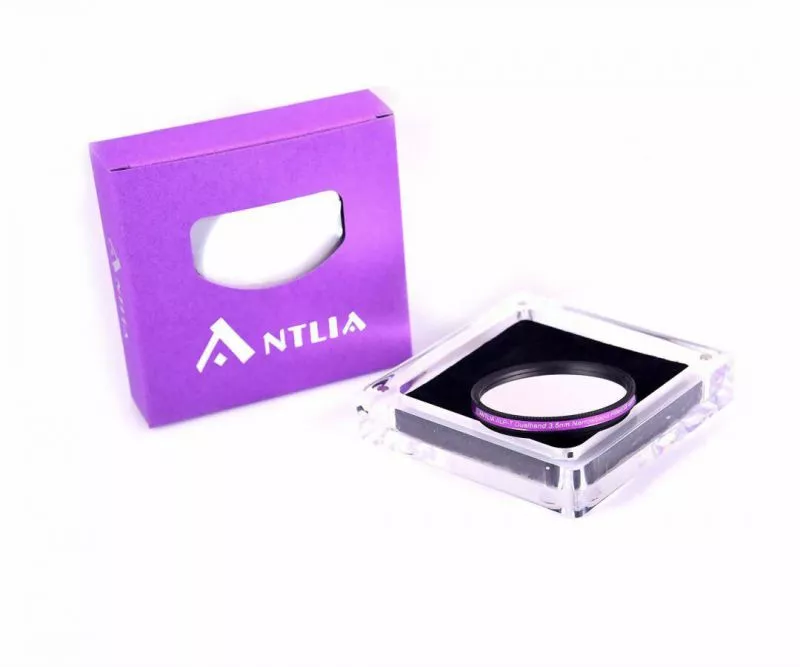
Supplied in a practical plastic carrying case
Antlia ALP-T Dual-Band 3.5 nm Narrowband Nebula Filter for Black and White and Color Cameras
Antlia developed this 3.5 nm dual-line-pass filter for one-shot color cameras (OSC), DSLRs, and mirrorless system cameras. It can also be used as a narrow-band filter for monochrome cameras to save valuable shooting time and produce extremely high-contrast luminous images, even in moonlight and near cities.
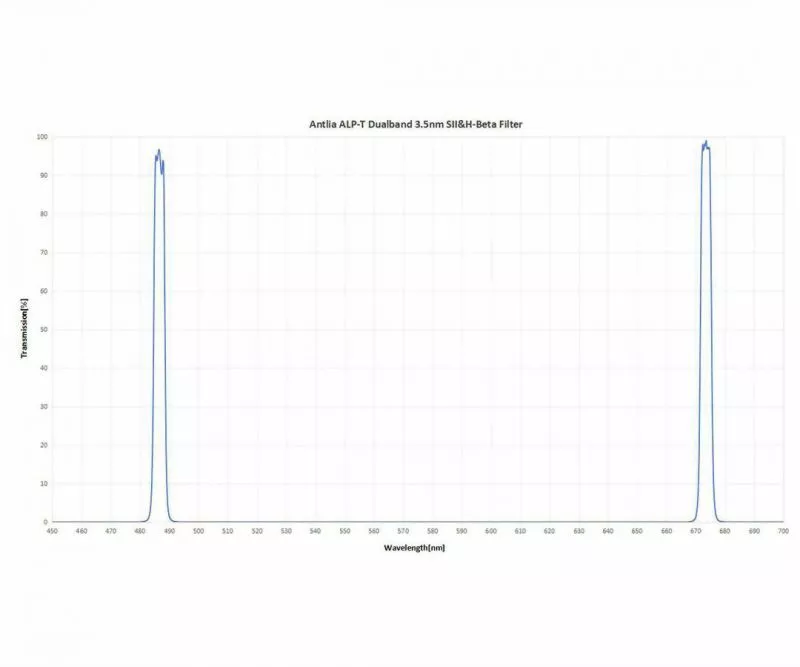
The ALP-T dual-band filter transmits red [S II] light (672.4 nm) and blue-green H-beta light (486.1 nm) and blocks all other wavelengths. In particular, the unwanted wavelengths of light pollution and airglow are blocked. This allows you to capture deep-sky images even in moonlight and near cities. The signal-to-noise ratio is greatly increased, allowing even the faintest nebulae to be captured.
The filter is an important complement to the popular Antlia ALP-T dual-band 3 nm Ha&O III filter. The combination of these two dual-band filters enables extremely narrowband images with OSC cameras by capturing spectral data from four channels: H-alpha/O-III/S-II/H-beta. The spectrum of these four channels can be decomposed and recombined into different color palettes in post-processing. The resulting images can be used to enhance the luminance contrast of conventional RGB-balanced images or to create images in various common false-color palettes such as H-O-Hb, S-H-O, H-S-OHb, H-O-O, etc.
Why are S-II and H-beta bands transmitted instead of O-III and S-II bands?
The filter is designed to capture H-beta and [S II] emission lines. We know that [S II] is simply ionized sulfur, emitting light in the deep-red part of the spectrum beyond H-alpha, but the contribution of H-beta to emission lines in nebulae is often overlooked, even though it is the second most abundant hydrogen emission after H-alpha. Detecting more [O III] enhances the existing signal but does not provide additional information. However, H-beta has the potential to reveal structures not visible with [O III]. The design aims to detect the H-beta emission line in certain nebulae that contain some blue spectrum that cannot be detected by H-alpha, S II, and O III filters. In many nebula images, greater and richer detail is captured to achieve results with a better signal-to-noise ratio.
It is generally accepted that the [O III] signal makes a relatively weak contribution to nebula images. The sensitivity of the O III bandpass is an important factor for any nebula filter. Most color cameras (OSC) use an RGGB Bayer pattern. Using twice as many green pixels as red or blue pixels allows for significantly better capture of the [O III] signal. Furthermore, a higher [O III] signal can be achieved by additional exposure with the Antlia ALP-T Ha&O3 filter. The GB channels are then isolated and an O III channel is synthesized and added to the stack.
If you only want to add [S II] to your H-alpha and [O III] data, it is probably better to purchase a narrowband S II filter and obtain cleaner [S II] spectral emission. However, Antlia's new filter design (S II&H b) also includes the H beta emission line, resulting in a significant improvement in the contrast of nebulae and better separation of structures in H beta regions.
The quality features of Antlia narrowband filters at a glance:
High light transmission and narrow bandwidth to maximize contrast
Special coating reduces halos around bright stars; however, slight halos may occur and are not grounds for complaint!
A single substrate eliminates internal reflections
Use in light-polluted areas and dark locations
Extends exposure time in moonlight
Antlia narrowband Pro filters can be used down to f/4 systems with little signal loss
All Antlia narrowband filters are edge-blackened to prevent internal reflections from stray light
Superior optical reliability reduces image post-processing
Substrate: Optical glass
Filter thickness: 2 mm
Mount: Low-profile metal mount with M48x0.75 filter thread
Bandwidth: 3.5 nm
Central wavelengths: 672.4 nm (90% maximum transmission), 486.1 nm (85% maximum transmission)
Blocking of unwanted wavelengths: ≥OD4.5
Surface quality: S/D (scratch/dig) = 60/40 (Refer to MIL-O-13830)
Surface accuracy: Lambda/4 or better
This Product was added to our catalogue on 07/07/2025.
Categories
Quick purchase
Welcome back!
Last viewed:
555,00 EUR
19 % VAT incl. excl. Shipping costs
Features:Fog filter UHC OIII »
More information on your personal page »
Manufacturer
Shipping country
Payment methods

Die Box kann unter tpl_modified/boxes/box_miscellaneous.html verändert werden. Die Sprachvariablen befinden sich in der Datei tpl_modified/lang/german/lang_german.custom.
Teleskop-Spezialisten © 2026 | Template © 2009-2026 by modified eCommerce Shopsoftware